Tag Archives: bubbles

Understanding and Preventing Acrylic Surface Blistering on Concrete Substrates

Acrylic athletic surfacing systems—including hard court and cushioned variants for tennis, pickleball, and basketball—are the industry standard for durability and performance. However, coating detachment in the form of blistering can occur if moisture dynamics beneath and within the concrete slab are not properly managed.

This bulletin explains the root causes of blistering, proper construction standards to prevent it, and methods for remediation.

The Science of Blistering: Vapor and Hydrostatic Pressure

Acrylic court coatings are engineered to be semi-permeable. This “breathability” allows microscopic amounts of moisture vapor to safely escape the system without compromising adhesion.

However, issues arise when the volume of moisture beneath the slab exceeds what the coatings can naturally vent:

Capillary Action & Solar Heat: While concrete appears solid, it is actually porous, containing a network of microscopic capillaries. When the sun beats down on the court surface, it creates a thermal draw, pulling moisture upward through these capillaries as water vapor.

Hydrostatic Pressure: If there is excessive water accumulation beneath the concrete, the upward pressure (hydrostatic pressure) overwhelms the chemical bond of the acrylic coatings.

System Thickness: This phenomenon is particularly critical for cushioned court systems. Because cushioned systems utilize thicker layers and more total coats of material, their overall breathability is naturally reduced, making proper moisture mitigation even more vital.

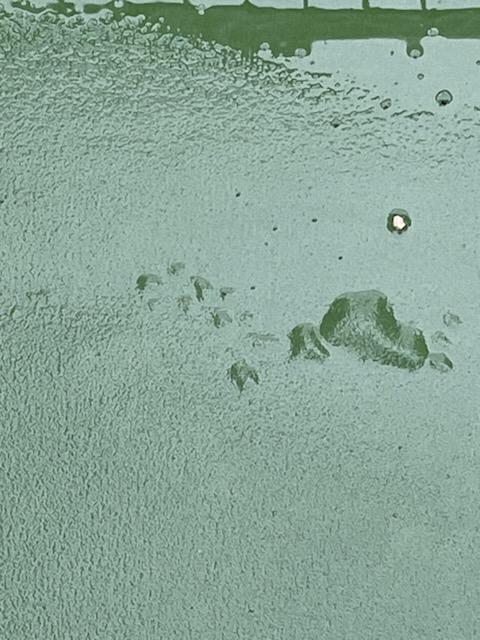
When hydrostatic pressure exceeds the coating’s bond strength, the material detaches from the substrate, resulting in fluid- or vapor-filled blisters.
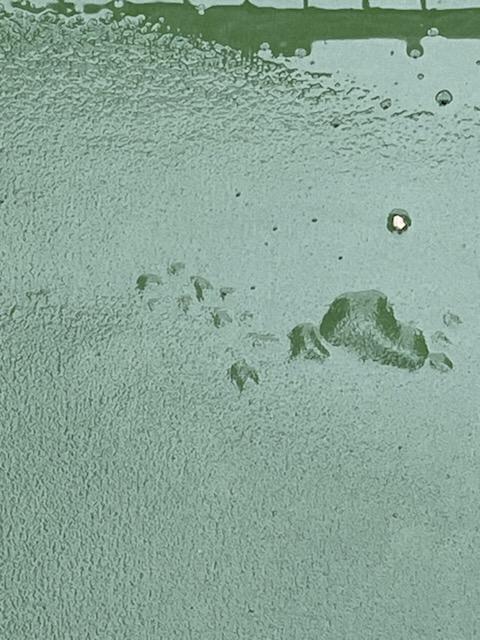
Bubbles and blisters on concrete pickleball court

Concrete Preparation for Maximum Coating Adhesion

Achieving an optimal physical and chemical bond is critical to preventing delamination and blistering. The following surface preparation protocols must be strictly enforced before applying any SportMaster materials:

No Curing Compounds: Ensure absolutely no curing compounds are used on the concrete surface during the curing process. These compounds form a barrier that blocks the acrylic coatings from penetrating and bonding to the concrete.

Surface Profile (Physical Bond): The concrete surface must be finished with a medium-broom finish, or mechanical profile achieving a Concrete Surface Profile (CSP) of 3 to 4. A surface that is too smooth lacks the necessary mechanical anchor pattern required for an enduring physical bond.

Acid Etching & pH Balancing (Chemical Bond): After allowing the concrete to cure for a minimum of 28 days, the surface must be acid etched using properly diluted muriatic or phosphoric acid. This process neutralizes the high alkalinity inherent in new concrete, providing a neutral pH profile ideal for an optimal chemical bond.

Preventive Construction Standards (ASBA Guidelines)

To prevent moisture from entering the concrete slab, court construction must strictly adhere to the American Sports Builders Association (ASBA) guidelines regarding drainage and vapor barriers.

1. Under-Slab Vapor Barrier
A robust moisture barrier must be installed directly beneath the concrete slab during construction:

Specification: A minimum of 2 layers of 6 mil polyethylene sheeting must be utilized.

Installation: Sheeting must be laid in opposite, alternating directions with all seams overlapping and securely taped to form an impermeable seal.

2. Perimeter Drainage (French Drains)
Even with an under-slab barrier, water can migrate laterally from the court’s surroundings. If water hits the edge of the slab, it can bypass the barrier and travel between the polyethylene sheeting and the concrete.

Requirement: Continuous perimeter drainage, such as French drains, must be installed around the entire perimeter of the court to redirect ground and surface water away from the slab.

3. Surface Slope and Drainage
Surface water that sits too long can also soak downward through the semi-permeable coatings, only to be pulled back up by solar heat, generating top-down blistering.

Slope Specification: The concrete slab must be properly sloped at a 1% tilt in one direction (equivalent to a 1-inch fall for every 10 feet).

The “Nickel Test”: No low areas should hold puddled water for more than 1 hour after a rain event. Any standing water must not exceed the thickness of a standard nickel.
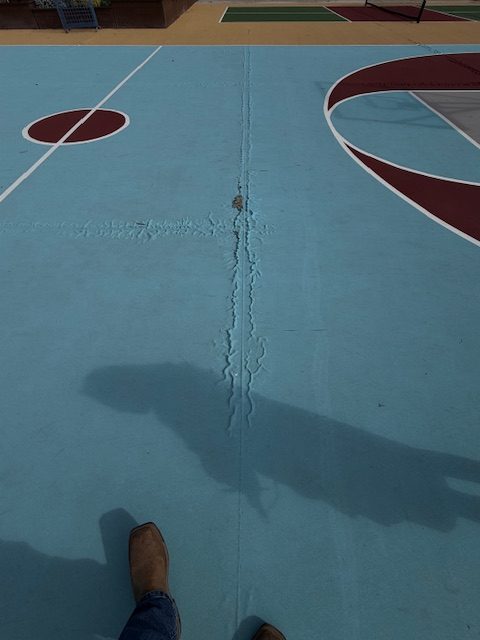
trapped moisture around saw joints

Repair and Remediation

CRITICAL STEP: Do not attempt aesthetic surface repairs until the root cause of the water accumulation beneath the slab has been completely diagnosed and corrected. If the drainage failure is not fixed, new blisters will inevitably form.

Once sub-surface moisture issues are resolved, existing blisters can be repaired using the following methods:

For Intact (Unpopped) Blisters:
Use a small syringe to inject a small amount of SportMaster Acrylic Patch Binder liquid directly into the blister cavity.

Place a heavy weight over the area to press the coating back into contact with the concrete substrate until cured, effectively reattaching the layer.

For Popped, Peeled, or Damaged Blisters:
Scrape away all loose, delaminated coating materials down to a sound, clean concrete substrate.

Level the depression using SportMaster Acrylic Resurfacer (incorporate CushionMaster products if repairing a cushioned system) to bring the area flush with the surrounding court surface.

Apply matching SportMaster color coatings to touch up and restore the visual uniformity of the playing surface.

For additional technical assistance, specification documents, or product inquiries, please contact your local SportMaster representative.

Importance of Power Troweling Concrete for Sport Surfaces

Power troweling is a vital step in preparing post-tension & reinforced concrete tennis courts for a medium broom finish and the application of 100% acrylic coating systems. This process significantly influences the long-term performance, durability, and appearance of the finished court. It also plays a critical role in minimizing issues such as water intrusion, blistering, and peeling of coatings. Here’s why power troweling is essential:

  1. Creates a Dense, Uniform Surface
  • Power troweling compacts and smooths the fresh concrete surface, resulting in a dense and consistent slab.
  • This uniformity is especially important for post-tension concrete, which is subject to internal stresses and movement. A properly troweled surface helps minimize future irregularities and maintains the structural integrity of the slab.
  • It also ensures the surface is level and free of significant high or low spots, which helps support proper water drainage and uniform coating coverage.
  1. Minimizes Surface Capillaries
  • One of the key benefits of power troweling is the reduction of surface capillaries—the tiny channels within uncured concrete that can absorb and transport moisture.
  • By densifying the surface and closing these capillaries, power troweling significantly reduces the potential for moisture intrusion from below or within the slab.
  • This is crucial for preventing issues like blistering, bubbling, or peeling of acrylic coatings, which are often caused by trapped moisture vapor escaping through the coating system after application.

Blisters on Court Surface

  1. Establishes a Stable Base for Broom Finish
  • Once the concrete is troweled, a medium broom finish can be applied to create a uniform surface texture that is ideal for coating.
  • Troweling ensures the broom finish is laid over a stable, well-consolidated substrate, which enhances its uniformity and reduces surface variability.
  • This consistency supports an even coating application and contributes to the overall aesthetic and performance quality of the court.
  1. Improves Coating Adhesion and Performance
  • 100% acrylic coatings require a clean, sound, and stable surface to bond effectively.
  • A troweled surface provides fewer voids and eliminates surface laitance or dusting that could otherwise interfere with coating adhesion.
  • This enhances the mechanical bond between the concrete and the coating system, reducing the likelihood of premature failure and helping the surface withstand environmental stressors over time.
  1. Increases Resistance to Surface Defects
  • Power troweling helps prevent common surface issues such as:
    • Dusting
    • Micro-cracking
    • Surface flaking or scaling
  • These defects, if left untreated, can compromise the performance and appearance of both the concrete and the coating system.
  • By producing a smooth, consolidated surface, troweling extends the functional life of the court.
  1. Aligns with Industry Standards
  • The use of power troweling followed by a broom finish is consistent with the American Sports Builders Association (ASBA) guidelines and coating manufacturers’ recommendations.
  • Following these best practices helps ensure the finished court meets performance, durability, and warranty standards.

Conclusion

Power troweling is not simply a finishing step—it’s a crucial part of preparing post-tension concrete tennis courts for a high-performance acrylic coating system. It enhances surface uniformity, minimizes capillary pores to reduce water intrusion, and ensures a stable base for both the broom finish and coatings. These benefits collectively prevent coating failure and extend the life and quality of the court. Proper troweling sets the foundation for a durable, professional-grade playing surface.

Are Acrylic Sport Surfaces Breathable And Permeable?

Question:  Are acrylic sport surfaces breathable and permeable?

Answer: Yes, SportMaster 100% acrylic sport surfaces are breathable and classified as semi-permeable.

Acrylic Sport Surfaces for Athletic Surfacing

SportMaster Sport Surfacing systems are produced using high-quality, 100% acrylic resins.  This is the industry-standard for sport surfacing on asphalt and concrete tennis, basketball, pickleball, and many other athletic and recreational court surfaces.  One of the main reasons for this is the fact that 100% acrylic resins are semi-permeable and allow a small to moderate amount of vapor transmission.

It is important to know that this does not mean you can have poor drainage and slope on a court surface and expect the acrylic coatings to “fix the problem”.  As a leading producer of acrylic sport surfaces, we strongly recommend following the construction guidelines of the American Sports Builders Assocation (ASBA).  The ASBA maintains an updated library of publications that demonstrate the right way to build tennis, pickleball, and athletic courts, along with running tracks and other recreational surfaces.  If athletic surfaces are not properly engineered, drained, and constructed, our (and any other) sport surfacing systems may exhibit bubbles, blisters, or failure.

Multi-sport acrylic surfaces


Asphalt & Concrete Athletic Court Construction

The recommended slope, for asphalt & concrete athletic court construction, is 1%.  This should be 1″ fall per every 10 feet of surface, in one direction.  This is enough pitch to allow runoff of water, without creating issues for the players.  Courts will be able to drain quickly and re-open for play.  Plus, acrylic coatings do not like to be constantly submerged, or the coatings will start to breakdown and wear at a quicker rate.

It is very important to have a professional drainage plan and make sure that water coming off of the court doesn’t accumulate beneath the slab.  Perimeter drains or other drainage plans, to take the water away from the courts and into the drainage system, is necessary.  Concrete courts should also be built with a vapor barrier to prevent hydrostatic pressure, in the form of water vapor, beneath the slab.  When the sun heats up the court surface, sub-surface water turns to vapor and creates vapor pressure to escape.  If enough water builds up beneath the slab and pushes upwards, it can create bubbles and blisters in the coatings and lead to peeling.

Important Factors For Sport Surfacing Success

    • Consult an experienced sport architect/engineer
    • Hire a qualified sport construction & surfacing contractor
    • Stick with 100% acrylic primers and coating systems throughout the entire sport surfacing system.
    • Follow the manufacturers specifications and recommendations
    • Don’t cut corners on proper construction and drainage.  It will only cost you more down the road

SportMaster Tennis Court Surfaces

What causes bubbles or blisters on a tennis court surface?

Bubbles and blisters on a tennis court surface, or other coated sport surface, are fairly common.  This is usually a result of improper tennis court construction or malfunction of the drainage system. When sub-surface water becomes excessive and is not properly drained away from the court, it can breathe through the slab in a vapor form and create hydrostatic pressure under the coatings.  This pressure builds more in weaker surface areas and creates a blister or bubble.  When the blister is raised, water vapor stretches the coating film and slowly breathes through to escape.  After most of the water pushes through, blisters usually lay back down and disappear until the next rain or precipitation event.  It’s important to note that excessive watering (sprinklers) around the court edge can also lead to blistering problems.  That being said, it’s very important to minimize accumulation of water beneath the court slab.

bubbles blisters pickleball court surface
Bubbles or Blisters on Court Surface

How Do I Get Rid of Bubbles and Blisters on a Tennis Court Surface?

In order to take care of the bubbles and blisters, long term, you will need to do some investigating.  Start by making sure any and all drains around the tennis court are free of debris or anything that would prevent proper flow of drainage water.  You may want to enlist the help of an architect or excavation professional in order to evaluate the current drainage system and see if it was installed properly, or at all.  If the court substrate is concrete, you must ensure the following:

  • Was a vapor barrier installed beneath the court when poured?
  • Are there perimeter drains that can take the water away from the court when it runs off after a rain? (Important that water is intercepted on all side of the slab, to prevent water beneath the court)
  • Was the concrete allowed to cure for 28 days, prior to coating?
  • Was the concrete surface acid etched to neutralize the alkalinity and balance the PH?
  • Were any curing compounds used on the concrete?
Court Surface Edge Drain
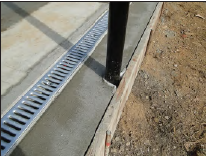
Surface-type drain – good for the low court edge


The American Sports Builders Association (ASBA) maintains construction guidelines for asphalt and concrete tennis court and sport surfaces.  Ensure that the construction of the court meets their guidelines and find out from the tennis court builder if they followed the ASBA recommendations.  This may help you figure out why the blisters are occurring.  If you are still not sure what to do, feel free to fill out the contact form on this page and we can put you in touch with a SportMaster recommended, tennis court builder.  They can perform a free site visit with you and provide feedback and estimates for repair, resurfacing, or re-construction. You can view our Engineering Specification for Athletic and Recreational Surfacing on our SportMaster site.

Tennis Court Blisters